Overband Magnetic Separator Buying Guide: Key Factors to Consider Before You Invest
A single piece of stray iron on a conveyor belt can wreck a crusher jaw, tear a screen deck, or shut a cement mill down for hours.
That is the risk of overband magnetic separators are built to remove. But buying the wrong one is almost as costly as buying none. Undersized units miss tramp iron. Oversized units drive up capital and power costs for no gain.
Drawing on more than four decades of engineering experience at Jaykrishna Magnetics Pvt. Ltd. , this guide walks you through the technical and commercial factors that actually decide whether an overband magnetic separator will protect your line for the next 15 years or become an expensive lesson in specification.
What Is an Overband Magnetic Separator and Where Does It Fit?
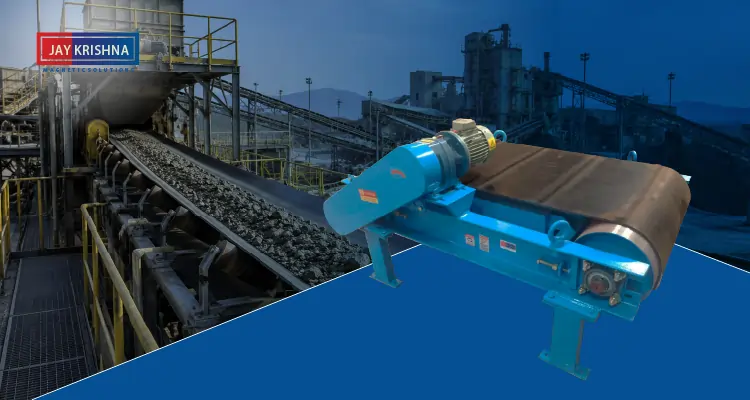
An overband magnetic separator, also called a suspension magnet or overbelt separator, is an electromagnetic or permanent magnet unit suspended above a conveyor belt. As material moves under the magnet, ferrous contaminants such as bolts, tools, rebar, and stray steel are pulled upward and either held on the magnet’s face (manual clean) or discharged sideways by a self-cleaning belt.
These separators are standard equipment across cement plants, mining and quarrying operations, coal handling systems, thermal power stations, glass and ceramic units, foundries, wood and biomass processing, MSW recycling, and scrap yards.
In every case the job is the same: protect downstream crushers, mills, and screens from tramp iron damage, and recover ferrous metal where it has resale value.
Electromagnetic vs Permanent Magnet: Which One Fits Your Application?
Electromagnetic overband separators suit deep burden depths, heavy tonnages, and coarse material. Permanent magnet overband separators suit shallow burden, remote installations, and applications where continuous power availability is limited.
Electromagnetic units (EMOB) use a wound copper or aluminium coil energized by a DC rectifier. Field strength can be tuned to the application, and the deeper reach makes them the default choice for burden depths above 200 mm, top sizes above 150 mm, or high-tonnage streams above 500 TPH. They do draw continuous power and need periodic checks on the rectifier and cooling system.
Permanent magnet units (PMOB) use ferrite or rare earth magnet assemblies. They draw no power in operation, need no rectifier, and require almost no electrical maintenance. However, their field decays faster with distance, which limits them to lighter duty applications with burden depths typically below 200 mm.
The table below sets the two technologies side by side for quick reference.
| Parameter | Electromagnetic (EMOB) | Permanent Magnet (PMOB) |
|---|---|---|
| Magnetic source | Wound copper or aluminium coil energised by a DC rectifier | Ferrite or rare earth magnet assembly |
| Power consumption | Continuous power required during operation | Zero power draw in operation |
| Field strength | Higher and adjustable, deeper effective reach | Fixed, shorter effective reach |
| Burden depth suitability | Above 200 mm, up to 500 mm and beyond | Typically, below 200 mm |
| Tonnage range | Medium to very high (500 TPH and above) | Light to medium duty applications |
| Capital cost | Higher | Lower |
| Operating cost | Higher due to power, cooling, and rectifier upkeep | Very low, minimal running expense |
| Maintenance | Rectifier, coil insulation, and cooling checks required | Minimal, mostly mechanical (belt and bearings) |
| Field decay over time | None, energised on demand | Negligible, less than 1% over 10 years |
| Best suited for | Cement, mining, coal handling, heavy recycling, foundries | Small recycling, food processing, ceramics, remote sites |
A short rule of thumb: if you can install the magnet close to a light, consistent burden, a permanent unit will pay for itself in power savings. If burden depth or tonnage is high, invest in an electromagnetic unit.
Key Factor 1: Belt Width, Suspension Height, and Burden Depth
These three variables sit together because they decide the size and strength of the magnet you need. Get any one of them wrong and separation efficiency drops sharply.
1. Belt Width :
The magnet face should be 100 to 200 mm wider than the conveyor belt on either side. A common mistake is specifying a magnet with the same width as the belt, which lets ferrous contaminants at the belt edges pass through unpicked. On troughed conveyors, remember that the effective material width is narrower than the flat belt width, so measure carefully.
2. Suspension Height:
Suspension height is the vertical distance from the magnet to the top of the burden. The higher the suspension, the stronger the magnetic field is required to reach the material. Standard suspension heights range from 250 to 500 mm depending on burden depth and material type. Do not ask the magnet to reach further than it was designed for.
3. Burden Depth:
Burden depth is the actual layer thickness of material on the belt. Deep burdens shield ferrous contaminants at the bottom of the load from the magnetic field, so you need either a stronger magnet, a slower belt speed, or both. Underestimating burden depth is one of the most frequent causes of underperforming installations. Measure it under normal running load, not at start-up.
Key Factor 2: Self-Cleaning vs Manual Cleaning Design
Self-cleaning overband separatorsare the standard for continuous operations. Manual cleaning units are only economical where tramp iron loads are very low, and short daily downtime cleaning is acceptable.
Self-cleaning designs use a cross-belt that runs continuously across the face of the magnet. Ferrous material is picked up, carried across, and discharged into a collection bin outside the main product stream.
This lets the separator run 24 hours a day without operator intervention and gives you a clean, continuous view of the tramp iron being removed.
Manual cleaning units have no cross-belts. Iron accumulates on the magnet’s face until an operator de-energizes the unit (or physically scrapes it, in the case of permanent magnets) and clears the load. This is workable only for low-volume, intermittent operations, and even then, it introduces a safety exposure most modern plants prefer to avoid.
For most of the Indian mining, cement, power, and recycling applications, self-cleaning is the only sensible choice. The additional capital cost is recovered quickly through avoided downtime and higher recovery rates.
Key Factor 3: Duty Cycle, Power Supply, and Cooling
Overband magnetic separators work in some of the harshest industrial environments in the country. High ambient temperatures, heavy dust, moisture, and continuous operation all put stress on the electrical system. Match the specification to your operating reality, not to a datasheet designed for European conditions.
1. Duty Cycle :
Confirm whether the unit is rated for continuous S1 duty or intermittent duty. Cement, mining, coal handling, and power plants almost always require continuous rated units. A separator rated for intermittent duty will overheat within days on a 24/7 line.
2. Coil Insulation Class:
Class F insulation (155°C) is the standard baseline. Class H insulation (180°C) is strongly preferred for high ambient conditions in Indian summers, particularly when the separator sits over a hot material stream such as clinker or hot slag.
3. Cooling System:
Naturally cooled (air-cooled) units are simpler and lower in capital cost. Oil-cooled units run cooler under continuous heavy loads and last significantly longer in hot environments but require periodic oil condition monitoring. Match the cooling to your duty cycle and ambient temperature, not to the lowest price.
4. Rectifier and Control Panel:
The rectifier must be sized correctly for the coil, protected against Indian grid voltage fluctuations, and housed in a control panel rated at least IP54 for dusty plant environments. Ask specifically about surge protection and phase failure protection. These are common failure points and often the cheapest part of the specification to upgrade.
Key Factor 4: Construction Quality and Materials
The magnet is only as reliable as the enclosure, cross-belt, and mechanical structure holding it together. This is where many buyers underspecify to save on capital cost, then pay for it in reduced service life and higher spares consumption.
Look for the following in any serious offer:
- Heavy gauge welded steel enclosures with adequate ribbing to resist impact from ejected tramp iron
- Sealed bearings on the cross-belt drive and idler pulleys, rated for high dust environments
- Rubber cross-belt with steel cord reinforcement or heavy fabric plies, sized for the expected tramp iron weight and abrasion
- Cleats or ribs on the cross-belt matched to the size of iron being removed, so heavy pieces do not slip back into the product stream
- IP54 or higher electrical enclosures with proper cable glanding
- Lifting lugs, safety chains, and suspension hardware rated at least three times the total magnet weight
Ask the manufacturer for a full material specification sheet, not just a brochure. If they cannot produce one, treat that as a warning sign.
Key Factor 5: After-Sales Support and Manufacturer Track Record
An overband magnetic separator is a 15-to-20-year asset. The manufacturer’s ability to support that asset over its lifetime matters as much as the initial specification. A cheap unit from a supplier who cannot deliver spares in three weeks is not cheap.
Before you finalize a purchase, verify:
- How many years the manufacturer has been building overband separators specifically, not just magnetic products in general
- Reference installations in your industry, ideally with belt widths, tonnages, and burden depths like yours
- Availability of spares: cross-belts, bearings, rectifiers, cleats, and coils
- Typical response time for site service in your region
- Written warranty terms, including exactly what is covered and what is not
- Whether the manufacturer offers a pre-installation site survey and post-commissioning support
Common Mistakes Buyers Make
Three mistakes come up repeatedly during purchase decisions:
1. Buying on price alone. A cheaper magnet with the wrong field strength or the wrong duty rating costs far more over its life through missed tramp iron, damaged crushers, and unplanned downtime.
2. Ignoring burden depth. Buyers specify belt width and forget the depth of material actually being conveyed. The result is a magnet that looks correct on paper but cannot reach the ferrous contaminants at the bottom of the load.
3. Treating installation is straightforward. Suspension height, structural support, discharge chute design, and integration with belt speed all affect performance. Skipping the pre-installation engineering review is where most underperforming installations begin.
Why Choose Jaykrishna Magnetics Pvt. Ltd.
Jaykrishna Magnetics Pvt. Ltd. has been designing and manufacturing magnetic separation equipment since 1978, with overband magnetic separators forming one of the core product lines built for the demands of Indian industry. Buyers work with us for a few consistent reasons.
- Over four decades of engineering focus. What began as a small engineering unit under founder Shri Manharlal H Maniar has grown into one of India’s most trusted magnetic equipment manufacturers, with more than 5,000 customers across mining, cement, power, recycling, food processing, chemical, ceramic, and foundry industries.
- Trusted by leading Indian industrial names. Our installed base includes projects for Reliance, TATA Chemical, Aditya Birla, Nirma, and other major process operations where downtime is not an option.
- Complete in-house capability. Design, magnet assembly, coil winding, fabrication, and testing all happen in Ahmedabad. This shortens delivery, keeps quality control tight, and lets us customise specifications without the delays a trader-model supplier introduces.
- Full technology ranges under one roof. Our overband product line covers electromagnetic (naturally air-cooled and oil-cooled), permanent magnet ferrite, and rare earth variants. You are never pushed into one technology because that is all we build. We recommend the right fit for your burden depth, tonnage, and power availability.
- Application-first engineering. Every enquiry is reviewed by an engineer, not just a sales team. We ask about belt width, burden depth, material characteristics, ambient conditions, and duty cycle before quoting, because those details decide performance for the next 20 years.
- Proven spares and service networks. With decades of installations across India and export markets worldwide, spares availability and site service response are already built into our operations, not promised for later.
- Global reach, local presence. Beyond a strong domestic base, our equipment is supplied and supported across international markets, backed by a manufacturing setup and engineering team based in Ahmedabad, Gujarat.
Conclusion
Specifying an overband magnetic separator, well takes time upfront, but that time decides how the equipment performs for the next two decades.
The steps are straightforward if you follow them in order: match the technology (electromagnetic or permanent) to your burden depth and tonnage, size the magnet face 100 to 200 mm wider than your belt on each side, set the suspension height honestly against real running burden, choose self-cleaning for anything running around the clock, and specify the duty cycle, insulation class, and cooling system for Indian ambient conditions rather than European ones.
Verify construction quality on paper before signing and stress-test the manufacturer’s ability to support you long after commissioning.
If you would like a technical assessment of your application, the engineering team at Jaykrishna Magnetics Pvt. Ltd. has been designing and manufacturing overband magnetic separators for over four decades across mining, cement, power, recycling, and process industries in India and internationally.
Share your belt width, burden depth, tonnage, material characteristics, and duty cycle, and we will come back with the right configuration, a clear specification sheet, and a straight answer on delivery.
Frequently Asked Questions (FAQs)
1. How long does an overband magnetic separator last?
A well-specified electromagnetic overband separator from an established manufacturer typically operates reliably for 15 to 20 years, provided the rectifier is maintained, and the cross-belt is replaced on schedule. Permanent magnet units, with no coil to fatigue, can last even longer if the magnetic assembly is protected from excessive heat.
2. Can one separator handle multiple conveyor lines?
No. Each overband magnetic separator is sized for a specific belt width, burden depth, and material type. Even lines with similar tonnages usually need dedicated units to guarantee separation efficiency and protect downstream equipment.
3. What is the difference between an overband separator and a magnetic pulley?
An overband separator hangs above the conveyor and lifts ferrous material up and away from the product stream. A magnetic pulley replaces the head pulley of the conveyor and separates iron as material falls off the end. Overband units offer better separation efficiency and are the standard for critical protection duties, while magnetic pulleys work well as a low-cost secondary defence.
4. Do permanent overband separators lose strength over time?
Modern rare earth and ferrite assemblies show negligible field decay over their working life, typically less than 1% over ten years, if the magnet is not exposed to temperatures above its rated limit. Physical impact of damage and overheating are the more likely causes of reduced performance, not natural decay.
5. What tonnage range do overband magnetic separators handle?
Standard overband magnetic separators handle conveyor throughputs from about 20 TPH in small recycling lines up to 2,000 TPH and beyond in large mining and cement operations. The correct sizing depends on burden depth, belt speed, and material characteristics, not tonnage alone.