How to Separate Ferrous and Non-Ferrous Metals in a Recycling Plant
A shredded stream of mixed scrap has real money sitting inside it: steel a mill will pay for, aluminum and copper that command a premium, and stainless steel that a buyer will reject outright as contamination. The equipment that pulls these fractions apart, cleanly and continuously, is what decides whether a recycling line turns a profit or ships out a low-grade mix that gets discounted at the gate.
Ferrous and non-ferrous metals do not respond to the same separation technology, and treating them as one problem is where a lot of recovered value gets lost. Ferrous metals such as iron and carbon steel are strongly magnetic and can be pulled out with a standard magnetic separator. Common non-ferrous metals such as aluminum, copper, brass, and zinc are not ferromagnetic and require a different separation principle for recovery.
This guide explains how ferrous and non-ferrous separation actually works, where each type of equipment fits in a typical recycling line, and what to check before specifying a magnetic separator or an eddy current separator for your material stream. There is also a case that trips up a lot of buyers: stainless steel is ferrous by composition, but its magnetic response varies significantly by grade and processing history. We will cover that too.
Key Takeaways
- Ferrous and Non-Ferrous Metals Need Different Technology: Common ferrous metals like iron and carbon steel are strongly magnetic and can be lifted or diverted with a magnetic separator, while conductive non-ferrous metals such as aluminum and copper are not ferromagnetic and are typically recovered with eddy current separation.
- Magnetic Separation Comes First in the Line: Overband magnetic separators and drum type magnetic separators typically remove ferrous tramp metal early in the process, both to recover steel and to protect crushers, shredders, and screens further down the line.
- Eddy Current Separators Recover the Non-Ferrous Fraction: A high-speed rotor inside the eddy current separator induces a repelling force in conductive, non-ferromagnetic metals, ejecting aluminum, copper, and brass out of the material stream.
- Sequence Matters: Running ferrous separation before non-ferrous separation helps keep strongly magnetic steel away from the eddy current rotor, where trapped ferrous pieces can cause heating or mechanical damage, and it produces a cleaner non-ferrous fraction.
- Stainless Steel Needs Special Handling: Stainless steel is ferrous by composition, but its magnetic response varies by grade. Where low-magnetic or paramagnetic stainless remains after conventional ferrous separation, some lines add a dedicated high-intensity stainless steel separation stage.
- Particle Size and Feed Rate Affect Recovery: Both magnetic and eddy current separators perform best when material is fed evenly at a controlled depth, since surging or unevenly distributed particles reduce separation accuracy.
- Custom Configuration Beats a One-Size-Fits-All Machine: Belt width, drum size, and rotor speed all need to match your actual throughput and material mix, which is why separation equipment for a recycling line is usually specified per application.
- Combining Technologies Maximizes Recovery Value: Most well-performing recycling plants use magnetic separators, eddy current separators, and, where relevant, stainless steel separators together rather than relying on one machine to do the whole job.
What Is the Difference Between Ferrous and Non-Ferrous Metals?
Ferrous metals are iron-based metals and alloys. Many common ferrous materials in recycling, including carbon steel and cast iron, respond strongly to magnetic separation. Non-ferrous metals are metals in which iron is not the principal constituent; common recyclable non-ferrous metals such as aluminum, copper, brass, and zinc are not ferromagnetic and therefore pass through a conventional ferrous magnetic separator.
Common ferrous metals in a recycling stream include carbon steel, cast iron, and wrought iron. Common non-ferrous metals include aluminum, copper, brass, zinc, and lead. Stainless steel is also ferrous because iron is its principal constituent, but its magnetic response varies: austenitic grades generally show very low magnetic response in the annealed condition, while ferritic and martensitic grades are normally magnetic.
| Property | Ferrous Metals | Non-Ferrous Metals |
|---|---|---|
| Common examples | Carbon steel, cast iron, wrought iron | Aluminum, copper, brass, zinc, lead |
| Magnetic response | Many common ferrous materials are strongly magnetic; response varies by alloy | Common recycling examples are not ferromagnetic |
| Typical separation method | Magnetic separator (overband, drum, plate, grill) | Eddy current separator for conductive non-ferrous metals such as aluminum, copper, and brass |
| Where value comes from | Bulk steel scrap for remelting | Higher per-tonne value for aluminum, copper, and brass |
| Common risk if left in the stream | Can damage crushers, shredders, and screens | Lowers the purity and resale value of other recovered fractions |
Why Metal Separation Matters in a Recycling Plant
Leaving ferrous tramp metal in a material stream is a direct equipment risk. A bolt or a piece of rebar that reaches a shredder or crusher can chip blades, jam a screen deck, or force an unplanned shutdown. Leaving non-ferrous metal mixed into other fractions is a quieter but equally costly problem, since aluminum and copper are worth recovering on their own and reduce the resale value of glass, plastic, or fiber if they stay mixed in.
Getting the separation right also affects compliance and sustainability targets that many recycling facilities now report against, since higher-purity ferrous and non-ferrous fractions both sell for more and divert more material away from landfill.
If stray metal is already causing downtime or discounted loads on your line, Jaykrishna Magnetics Pvt. Ltd.’s engineering team can help you work out where ferrous or non-ferrous contamination is actually entering the stream. Let’s discuss your requirements.
How Ferrous Metal Separation Works
Ferrous separation relies on straightforward magnetic attraction, but where and how that magnet is positioned changes what it can actually catch.
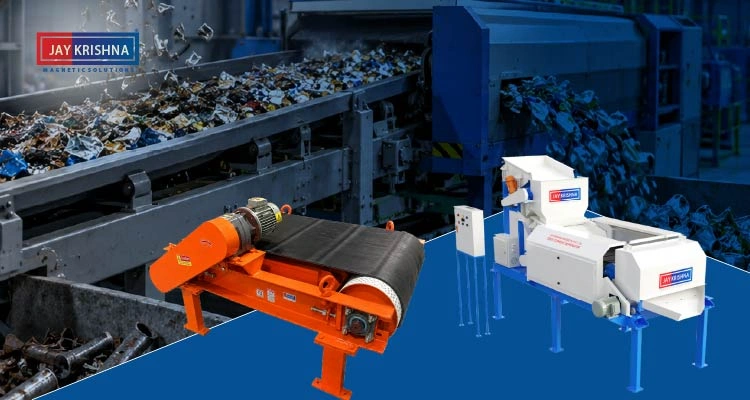
An overband magnetic separator is suspended above or across a conveyor and continuously lifts ferrous tramp metal off the belt as material passes underneath. Because the separating belt itself is self-cleaning, ferrous scrap is carried away and dropped into a collection point without stopping the line, which is why this is usually the first separation stage on a conveyor carrying shredded or bulk material.
A drum type magnetic separator works differently: a stationary magnet sits inside a rotating, non-magnetic drum shell. As material falls onto the drum, ferrous particles are held against the rotating surface by the magnetic field, while non-ferrous and non-metallic material falls away normally. Because the drum keeps turning, fresh magnetic surface is always exposed to incoming material, which makes this format effective on continuous, free-flowing bulk streams rather than just surface tramp metal. Drum separators are typically built with ferrite ceramic magnets for general tramp-iron duty, or with Neodymium (NdFeB) rare-earth magnets where weaker or finer magnetic particles need to be recovered.
For smaller or gravity-fed applications, such as a hopper, chute, or pipeline, plate magnets, grill magnets, and drawer magnets serve the same purpose on a smaller physical scale, catching ferrous contamination before it reaches downstream equipment.
How Non-Ferrous Metal Separation Works
A standard magnet has no effect on aluminum, copper, or brass because these metals are not ferromagnetic. Recovering them requires an eddy current separator, which works on an entirely different physical principle.
Inside an eddy current separator, a magnet-block rotor spins at high speed inside a non-metallic drum shell positioned at the discharge end of a short conveyor. As conductive, non-ferrous particles pass over the spinning rotor, the rapidly alternating magnetic field induces an electric current inside the metal itself. That induced current generates its own opposing magnetic field, and the resulting repelling force physically ejects the particle off its normal trajectory, over a splitter plate, and into a separate collection point. Non-metallic material and any remaining debris simply continue forward and fall by gravity.
On Jaykrishna Magnetics Pvt. Ltd.’s current eddy current separator page, the system is stated to separate about 97 percent of total non-ferrous impurities, while a separate application claim lists 98 percent recovery of aluminum cans from commingled recyclables. The page also states that particles can be sorted down to about 2 mm in diameter, although practical recovery at fine particle sizes depends on material properties, liberation, feed presentation, and operating conditions.
Confirmed applications include aluminum scrap recovery, e-waste recycling, municipal solid waste processing, glass cullet recycling, wire scrap, PET flakes, rubber scrap, and PVC scrap.
Handling the Stainless Steel Edge Case
Stainless steel is a ferrous alloy because iron is its principal constituent, but it does not behave uniformly in magnetic separation. Austenitic stainless steels generally have very low magnetic response in the annealed condition, while ferritic and martensitic stainless steels are normally magnetic. Cold working can also increase the magnetic response of some austenitic grades, so actual recoverability depends on the grade and condition of the scrap.
Where low-magnetic or paramagnetic stainless steel remains after conventional ferrous separation, some recycling lines add a dedicated high-intensity stainless steel separator as an additional stage. This avoids assuming that a standard ferrous magnet or an eddy current separator alone will recover every stainless steel fraction.
For lines that also need to isolate stainless steel from mixed scrap, Jaykrishna Magnetics Pvt. Ltd.’s engineering team can advise on where a dedicated separation stage would fit into your existing layout. Get in touch to walk through your material mix.
A Typical Ferrous and Non-Ferrous Separation Sequence
- Bulk material enters the main separation line after shredding or initial screening. Where oversized ferrous contamination could damage a crusher or shredder, a protective magnetic separator may also be installed upstream of the size-reduction stage.
- An overband magnetic separator suspended above the belt lifts out large ferrous tramp metal first, protecting downstream equipment.
- A drum type magnetic separator captures finer ferrous particles that the overband may miss, since its rotating surface continuously exposes fresh magnetic field to the flow.
- The now largely ferrous-free stream moves to an eddy current separator, where the high-speed rotor ejects non-ferrous metal such as aluminum and copper into a separate collection point.
- Where low-magnetic or paramagnetic stainless steel remains in the material mix, a dedicated high-intensity stainless steel separator can recover that fraction from the residual stream.
- The cleaned output streams, ferrous scrap, non-ferrous metal, and any residual stainless steel, are collected separately for sale or further processing.
Running the stages in this order matters for more than convenience. Ferrous metal should normally be removed before the eddy current separator because strongly magnetic pieces can be attracted toward the rotor area; if trapped near the belt, shell, or rotor, they can generate heat and cause mechanical damage. Upstream ferrous removal also helps produce a cleaner non-ferrous recovery stage.
Selecting the Right Separation Equipment for Your Material Stream
There is no single separator size that fits every recycling operation, and specifying equipment by belt width alone is a common and costly mistake. A few factors decide what actually works for your line:
- Material composition: The ratio of ferrous to non-ferrous content, and whether stainless steel is present, determines which stages you need at all.
- Particle size range: Very fine particles behave differently under both a magnetic field and an eddy current field than larger pieces, and equipment needs to be matched to your typical size distribution.
- Throughput and conveyor dimensions: Belt width, burden depth, and tons-per-hour targets determine drum size, rotor width, and motor sizing for your specific line, not a generic catalog listing.
- Moisture and debris levels: Wet or sticky material can reduce practical separation efficiency by causing buildup, agglomeration, or poor material presentation, which affects how much pre-processing or self-cleaning capability you need.
- Magnet type: Ferrite ceramic magnets are standard for routine tramp iron duty, while Neodymium (NdFeB) rare-earth magnets are used where finer or weakly magnetic particles need to be captured.
If you are comparing equipment for a new or upgraded recycling line, Jaykrishna Magnetics Pvt. Ltd.’s engineering team can help you size the right combination of ferrous and non-ferrous separation stages to your actual throughput. Request a FREE quote today.
Equipment Comparison
| Equipment | Metal Fraction Targeted | Typical Position in the Line | Best Suited For |
|---|---|---|---|
| Overband Magnetic Separator | Large, magnetically responsive ferrous tramp metal | Suspended above or across the main conveyor, typically early in the line | Continuous, self-cleaning removal of bolts, rebar, and similar ferrous contamination |
| Drum Type Magnetic Separator | Finer, distributed magnetic ferrous particles | In bulk free-flowing material streams, often after initial screening or as a cleanup stage | High-volume dry material where iron contamination runs throughout the flow |
| Eddy Current Separator | Conductive non-ferrous metals such as aluminum, copper, and brass | After ferrous separation, in the non-ferrous recovery stage | Recovering non-ferrous value from municipal solid waste, e-waste, and glass cullet |
| Stainless Steel Separator | Low-magnetic or paramagnetic stainless steel fractions | After conventional ferrous separation where residual stainless remains | Streams where stainless steel contamination affects product purity or resale grade |
Common Factors That Reduce Separation Efficiency
Even well-chosen equipment underperforms if these operating conditions are not managed:
- Uneven feed or surging material, which creates inconsistent exposure to the magnetic or eddy current field.
- Excess moisture or sticky debris, which can cause agglomeration, buildup, or material carryover and reduce practical separation efficiency.
- Particle sizes below the equipment’s practical threshold, since both magnetic and eddy current separation become less reliable on very fine fractions.
- An incorrect working gap or belt speed for the material’s density and burden depth.
- Using a ferrite magnet where fine or weakly magnetic material actually needs a rare-earth magnet, or vice versa where the extra field strength is not needed.
- Deferred maintenance, since worn belts, misaligned rotors, material buildup, and incorrect working gaps can gradually reduce recovery performance.
Where This Matters Most
Ferrous and non-ferrous separation is central to municipal solid waste recycling, scrap metal processing, e-waste recovery, glass cullet recycling, and foundry sand reclamation, all of which combine mixed metal contamination with a genuine recovery opportunity.
Jaykrishna Magnetics Pvt. Ltd.’s Recycling Solutions line brings the overband, drum type, and eddy current equipment covered in this guide together for exactly this kind of application, and the Recycling Industry page covers the broader equipment range relevant to a recycling facility.
Why Jaykrishna Magnetics Pvt. Ltd. for Ferrous and Non-Ferrous Metal Separation
Jaykrishna Magnetics Pvt. Ltd. was established in 1978 and is now led by its second generation, with in-house design and manufacturing at its Ahmedabad, Gujarat facility. The company’s Recycling Solutions line combines overband magnetic separators, drum type magnetic separators, and eddy current separators specifically for the kind of staged ferrous and non-ferrous recovery covered in this guide, rather than treating each machine as a standalone product.
Equipment is engineered to a customer’s actual belt width, throughput, and material mix rather than sold off a fixed catalog size. The company also maintains customer-support contacts in the USA and regional representative or partner contacts in Oman and Peru. For a recycling operation weighing up separation equipment, that combination of custom engineering and a dedicated recycling-focused product range is usually the more relevant starting point than any single spec sheet.
Conclusion
Separating ferrous and non-ferrous metals is not a single machine’s job. It is a sequence: magnetic separation removes magnetically responsive ferrous material and protects downstream equipment, eddy current separation recovers conductive non-ferrous metals that a conventional ferrous magnet cannot capture, and, where low-magnetic or paramagnetic stainless remains, a high-intensity stainless steel separation stage can recover that fraction. Getting the sequence, sizing, and magnet type right is what turns a mixed scrap stream into several sellable, higher-purity fractions instead of one discounted load.
If you are specifying separation equipment for a new recycling line or upgrading an existing one, Jaykrishna Magnetics Pvt. Ltd.’s engineering team can help you match the right combination of overband, drum type, and eddy current separators to your material stream and throughput. Request a FREE quote today or get in touch to discuss your requirements.
FAQs
1. How do I know whether my material stream needs ferrous separation, non-ferrous separation, or both?
If your feed contains iron or steel scrap, you need magnetic separation. If it also contains aluminum, copper, brass, or similar conductive metals, you need eddy current separation as well. Most recycling and scrap streams that mix multiple metal types need both, run in sequence rather than as a single step.
2. Can one machine remove both ferrous and non-ferrous metals?
No single standard machine handles both jobs well, because the two separations rely on different physical principles. A magnetic separator attracts magnetically responsive ferrous metal, while an eddy current separator repels conductive non-ferrous metal using induced currents, so most lines use both types of equipment together.
3. Why can’t a standard magnet remove aluminum or copper from a recycling line?
Aluminum and copper are not ferromagnetic, so they do not respond to a magnetic field the way iron or steel does. Recovering them requires an eddy current separator, which uses a rapidly rotating magnetic rotor to induce a current in the conductive metal and physically eject it from the stream.
4. Where should an eddy current separator be positioned relative to magnetic separators?
An eddy current separator should normally sit after ferrous separation, not before it. Strongly magnetic ferrous pieces can be attracted toward the rotor area and, if trapped near the belt, shell, or rotor, can generate heat or cause mechanical damage. Removing tramp iron first also helps improve the cleanliness of the non-ferrous recovery stage.
5. Can stainless steel be recovered along with ferrous and non-ferrous metals?
It depends on the grade and condition. Stainless steel is ferrous by composition, but ferritic and martensitic grades are normally magnetic while annealed austenitic grades generally have very low magnetic response. Where low-magnetic or paramagnetic stainless remains after conventional ferrous recovery, a dedicated high-intensity stainless steel separator may be required.
6. What affects how well an eddy current separator recovers non-ferrous metal?
Recovery depends on particle size, electrical conductivity, density, shape, degree of liberation, feed distribution, and rotor operating conditions. Very fine, poorly liberated, or unevenly distributed particles are harder to separate cleanly, which is why feed preparation and consistent presentation matter as much as the separator itself.