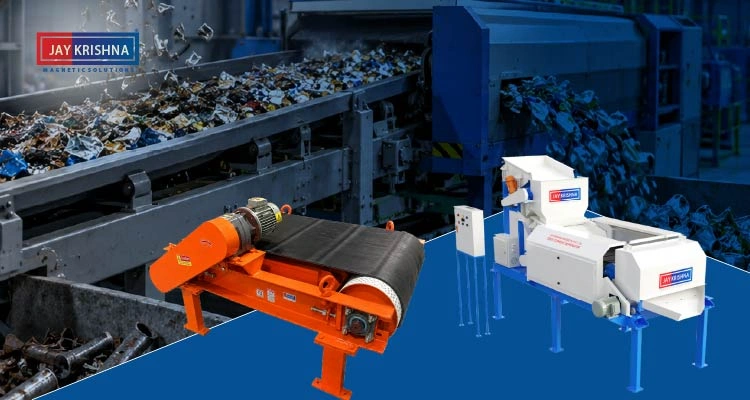
Common Problems in Metal Separation & How Eddy Current Separators Solve Them
Common Problems in Metal Separation & How Eddy Current Separators Solve Them
In the recycling and mining industries, metal separation is where profit is made or lost.
If you are a plant manager or process engineer, you know the struggle. You remove the iron and steel easily enough using standard magnets. But what about aluminum, copper, and brass?
Leaving these metals in the waste stream means throwing money away. Worse, if they contaminate your recycled plastic or glass, your product quality drops.
This is the gap that Eddy Current Separators (ECS) fill.
At Jaykrishna Magnetics Pvt. Ltd, we understand that efficient separation isn’t just about machinery; it’s about purity, throughput, and ROI. In this guide, we will explain the most common challenges in metal separation and how advanced ECS technology solves them.
What is an Eddy Current Separator?
An Eddy Current Separator is an advanced metal sorting machine used to remove non-ferrous metals (like aluminum and copper) from non-metallic streams (like plastic, glass, or wood).
Unlike standard magnets that attract iron, an ECS uses a high-speed magnetic rotor to create a repelling force. This force “throws” conductive metals away from the waste stream, allowing for clean, high-precision separation.
The Top 3 Challenges in Industrial Metal Separation
Before we look at the solution, we need to understand the problems. Most recycling plants face the same three issues when trying to sort materials.
1. The “Non-Ferrous” Blind Spot
Standard magnetic separators, like Overband Magnetic Separators or Magnetic Pulleys, are excellent at catching ferrous metals (iron and steel). However, they are “blind” to non-ferrous metals.
Without the right technology, valuable aluminum cans, copper wires, and brass fittings pass right through the system. This results in inefficient metal recovery and lost revenue.
2. Mixed Material Contamination
In industries like PET recycling or glass processing, purity is everything. Even a small amount of aluminum left in a batch of plastic flakes can ruin the extrusion process.
Manual sorting is often used to fix this, but it is slow, expensive, and liable to human error. Achieving high-purity levels (98%+) is nearly impossible with manual labor alone.
3. Low Throughput and High Maintenance
Old separation methods clog easily. If your material handling system isn’t efficient, your entire line slows down.
Many plants struggle with feeding materials evenly onto the separator. Without a consistent flow – often achieved using a Vibratory Feeder – the separation becomes messy and inefficient.
How Eddy Current Separators Solve These Problems
The Eddy Current Separator acts as the final quality control step in your recycling line. Here is how it tackles the challenges mentioned above.
It Targets the “Un-Magnetizable”
The core magic of the ECS is that it doesn’t need the metal to be magnetic. It uses physics to turn non-ferrous metals into temporary magnets that repel themselves.
- The Result: Aluminum, copper, and zinc are physically ejected from the stream.
- The Benefit: You capture the valuable scrap that used to go to the landfill.
It Automates High-Precision Sorting
Speed is critical in waste management. An ECS can handle massive volumes of material continuously.
Instead of depending on workers to pick out aluminum cans, the machine does it instantly and accurately. This automation leads to improving metal purity in recycling, allowing you to sell your recycled material at a premium price.
It Handles High Volumes with Grace
At Jaykrishna Magnetics, our ECS units are built for heavy industrial use. They are designed to work in parallel with other equipment.
For example, a Vibro Separator or Vibratory Feeder spreads the material out before it hits the belt. This ensures every piece of metal gets exposed to the magnetic field, maximizing recovery rates.
How Does Eddy Current Separators Work?
You don’t need a physics degree to understand this machine. Think of it as a “Reverse Magnet.
- The Conveyor: Material travels along a belt.
- The Rotor: At the end of the belt, a magnetic rotor spins at incredibly high speeds inside a non-metallic drum.
- The Eddy Current: This spinning creates a magnetic field. When a conductive metal (like aluminum) enters this field, it creates its own energy current (an Eddy Current).
- The Repulsion: This current reacts against the magnetic field, creating a repulsive force
- The Jump: The non-ferrous metal “jumps” over a splitter plate into a separate bin, while the non-metallic waste falls directly down.
Comparison: Magnetic Separator vs. Eddy Current Separator
To make the right choice, you need to know the difference. Here is a quick comparison.
| Feature | Magnetic Separator | Eddy Current Separator |
|---|---|---|
| Target Material | Ferrous Metals (Iron, Steel) | Non-Ferrous Metals (Aluminum, Copper) |
| Action | Attracts (Pulls metal) | Repels (Pushes metal away) |
| Main Use | Primary Separation | Secondary / Tertiary Separation |
| Common Types | Overband, Suspension Magnet | Eccentric or Concentric ECS |
| Cost | Lower | Higher (but high ROI) |
Industries That Need This Technology
Jaykrishna Magnetics supplies these systems to a wide range of sectors. If you work in one of these areas, an ECS is likely essential for your process.
1. Plastic and Glass Recycling
To recycle PET bottles or glass cullet, you must have zero metal contamination. An ECS removes aluminum caps and rings that standard magnets miss.
2. Electronic Waste (E-Waste)
E-waste is full of precious metals. After picking it up, an ECS helps separate the copper and aluminum from the plastic casing and circuit boards.
3. Wood and Timber Processing
Clean wood is required for biomass or chipboards. An ECS removes brass hinges, screws, or non-ferrous nails that could damage cutting blades or lower fuel quality.
4. Auto Shredding
When cars are scrapped, there is a lot of “ASR” (Auto Shredder Residue). An ECS recovers the valuable aluminum car parts from the rubber and foam.
Maximizing Efficiency: The Complete System
An Eddy Current Separator is powerful, but it works best as part of a team. At Jaykrishna Magnetics, we often design complete Magnetic Separation Systems.
- Vibratory Feeder: Spreads material evenly.
- Overband Magnetic Separator: Lifts out large steel pieces.
- Drum Magnet: Removes smaller iron particles.
- Eddy Current Separator: Ejects aluminum and copper.
- Sensor Sorters: For sorting stainless steel (which ECS might miss).
By combining these tools, you ensure 99% purity and protect your expensive machinery from damage.
Why Choose Jaykrishna Magnetics?
Selecting the right separator depends on your material. The belt speed, rotor position, and magnetic intensity all need to be tuned to your specific product.
Jaykrishna Magnetics Pvt. Ltd is a leader in manufacturing magnetic and vibratory equipment.
- Customization: We modified the machine to fit your material flow.
- Range: From Rare-Earth Magnetic Equipment to heavy-duty Suspension Magnets, we have it all.
- Expertise: We help you choose the right machine to ensure you get the best ROI.
Don’t let valuable metal go to waste. Upgrade your process today.
Do you need to improve your recycling purity? Consult with our Engineers Today
Ready to Optimize Your Plant?
Stop losing money on missing metals. Explore our full range of Magnetic Separators and Vibratory Equipment to find the perfect fit for your industry.
Get a Free Quote for Your Plant
Explore All Products
Frequently Asked Questions (FAQ)
1. What metals can an Eddy Current Separator remove?
It removes non-ferrous metals. This includes aluminum, copper, brass, zinc, and magnesium. It does not remove iron or steel (ferrous metals) and does not work well on stainless steel.
2. Can an Eddy Current Separator separate stainless steel?
Generally, no. Most grades of stainless steel have low conductivity and low magnetic permeability. For stainless steel, you might need a High-Intensity Magnetic Separator or sensor-based sorting.
3. Why do I need to remove iron before the ECS?
Iron is strongly magnetic. If large pieces of iron enter the high-speed magnetic field of an ECS, they can heat up rapidly and damage the belt or the rotor shell. Always use Magnetic Pulley or Overband Magnet first.
4. What affects the efficiency of an ECS?
Three main things:
- Particle Size: Larger pieces are easier to separate than dust.
- Moisture: Wet material can stick to the belt.
- Feed Rate: Overloading the belt prevents the metals from “jumping” cleanly.
5. What is the difference between Ferrous and Non-Ferrous metal separation?
Ferrous separation uses attraction (magnets pulling iron). Non-ferrous separation uses repulsion (ECS pushing aluminum away). You usually need both steps for complete recycling.