Eddy Current Separator for Washed Plastic Recycling – Everything You Need to Know
Key Takeaway
What is it? An Eddy Current Separator (ECS) is an advanced sorting machine that ejects non-ferrous metals (aluminum, copper) from non-metallic streams like plastic flakes.
Why use it? It achieves 98-99% purity in washed plastic recycling, protects downstream extruders, and significantly boosts the resale value of recycled PET/HDPE.
Who needs it? Any plastic recycling plant looking to automate metal removal and reduce manual labor.
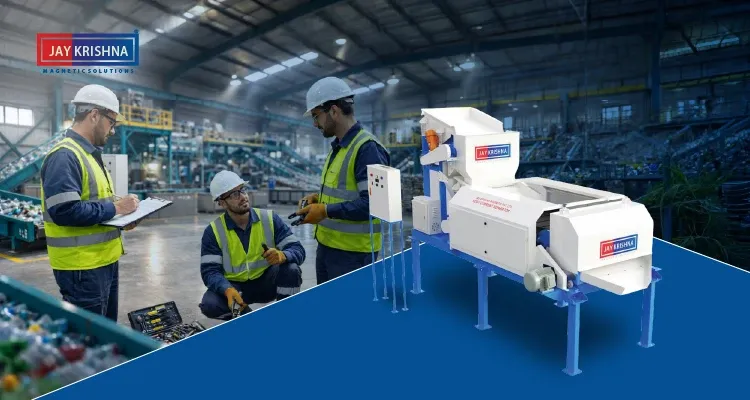
Features of an Eddy Current Separator
You have washed your plastic flakes. You have dried them. They look clean to the naked eye. But if you run a plastic recycling facility, you know the truth: invisible enemies are hiding in that stream.
Small fragments of aluminum caps, copper wires from e-waste, or brass shavings often survive the washing process. If these non-ferrous metals make it into the extruder, they don’t just lower your product’s quality—they can destroy expensive machinery and ruin your reputation with buyers.
This is where the Eddy Current Separator (ECS) changes the game.
As a leading magnetic machineries manufacturer, we at Jaykrishna Magnetics Pvt. Ltd. have seen firsthand how adding an ECS to a washing line transforms profitability. It is the difference between “recycled plastic” and “premium, high purity recycled resin.”
In this guide, we will break down exactly how this technology works, why it is non-negotiable for modern recycling plants, and how to choose the right one for your facility.
What is an Eddy Current Separator?
An Eddy Current Separator is a conveyor-based sorting machine designed to separate non-ferrous metals (like aluminum, copper, and zinc) from non-metallic materials (like plastic, glass, and wood).
While standard magnetic separators attract ferrous metals (iron, steel), an ECS does the opposite: it repels non-ferrous metals.
Think of it as a reverse magnet. Instead of grabbing the metal, it kicks it out of the plastic stream. This unique ability makes it the ultimate finishing tool for PET bottle recycling lines, mixed plastic sorting, and municipal waste recovery.
Note for Recyclers: If you are only using overband magnets, you are missing half the metal contamination. Overbands catch iron; Eddy Currents catch the aluminum that Overbands missed.
Why Is It Critical for Washed Plastic Recycling?
In the plastic recycling industry, purity is a currency.
Washed plastic flakes (PET, HDPE, PP) are sold based on their contamination levels (measured in parts per million, or PPM). A single aluminum ring from a bottle cap can downgrade an entire batch of clear PET flakes.
Here is why an ECS is essential for your line:
1. Increases Material Purity to 98-99%
Manual sorting cannot catch tiny aluminum shavings or wire fragments buried in plastic flakes. An ECS operates at high speeds and uses physics to eject these contaminants with surgical precision, ensuring your final product meets the highest industry standards.
2. Protects Your Extruder & Granulator
Non-ferrous metals are soft but dangerous. Melters and extruder screens can get clogged or damaged when molten plastic contains copper or aluminum. By removing these early, you extend the life of your downstream equipment.
3. Reduces Manual Labor
Reliance on human pickers is expensive and inconsistent. An ECS runs 24/7 without fatigue, automating the separation process and allowing your workforce to focus on tasks that require human judgment.
4. Recovers Valuable Metals
The “waste” ejected by the ECS is often high-grade of aluminum or copper. You aren’t just cleaning your plastic; you are creating a secondary revenue stream by selling the scrap metal.
How Does an Eddy Current Separator Work?
The science behind this machine is fascinating but simple to understand. It relies on Foucault’s currents, also known as “eddy currents.”
Here is the step-by-step process:
- The Setup: A conveyor belt carries the mixed material (plastic + metal) toward the discharge end.
- The Rotor: Inside the head pulley is a high-speed magnetic rotor lined with powerful rare earth magnets (neodymium). This rotor spins significantly faster than the belt itself (often 3000+ RPM).
- The Reaction: When a conductive metal (like an aluminum can piece) passes over this spinning magnetic field, an electrical current (eddy current) is induced inside the metal.
- The Repulsion: This induced current creates its own magnetic field that opposes the rotor field. It creates a strong repulsive force.
- The Separation: The plastic (which is non-conductive) simply falls off the end of the belt due to gravity. The aluminum (conductive) is physically repelled and jumps forward over a splitter plate into a separate bin.
In simple terms: Plastic falls; Aluminum jumps out.
Features of a High-Quality ECS
Not all separators are built the same. As a premier magnetic machineries Supplier, Jaykrishna Magnetics engineers our ECS units with specific features tailored for the Indian and global markets.
1. Eccentric Rotor Design
Our Eddy Masterclass eccentric rotor design ensures that the magnetic force is concentrated exactly where the separation happens. This prevents ferrous particles from getting trapped between the belt and the rotor, which is a common cause of belt damage in cheaper, concentric designs.
2. High-Frequency Rare Earth Magnets
We use high-grade Neodymium Iron Boron (NdFeB) magnets. These generate the intense magnetic flux required to separate even small particles, which is critical when dealing with shredded plastic flakes rather than whole bottles.
3. Vibratory Feeder Integration
For an ECS to work perfectly, the material must be spread in a single layer. We integrate Vibratory Equipment at the feeding stage to ensure the plastic flows evenly across the belt width, preventing “heaps” of material that could trap metal.
ECS vs. Other Separation Methods
Is an Eddy Current Separator right for you? Let’s compare it to other common methods used in plastic recycling.
| Feature | Eddy Current Separator | Overband Magnetic Separator | Manual Sorting |
|---|---|---|---|
| Target Material | Non-ferrous (Aluminum, Copper, Brass) | Ferrous (Iron, Steel, Mild Steel) | Large visible objects |
| Separation Size | Can handle small particles (3 mm+) | Medium to large ferrous items | Limited to human visibility |
| Speed | High (Continuous automatic flow) | Medium | Slow |
| Efficiency | 98%+ purity | Good for iron, ineffective for aluminum | Inconsistent (human error) |
| Operating Cost | Low (electricity only) | Low | High (wages) |
Verdict: For complete metal removal, you typically need both. An Overband Magnet (or Electromagnetic Equipment) removes the iron first, and the ECS acts as the final polisher for the aluminum.
Applications Beyond Plastic Recycling
While we are focusing on washed plastics, it is worth noting that a robust ECS is a versatile asset. As a magnetic machineries manufacturer, we supply these units to various sectors:
- Glass Recycling (Cullet): Removing aluminum caps from crushed glass.
- E-Waste Recycling: Separating copper wire from shredded circuit boards.
- Wood Processing: Removing brass hinges or screws from wood chips.
- Incinerator Ash: Recovering metals from bottom ash (IBA).
- Auto Shredder Residue (ASR): Recovering zinc and aluminum from car scrap.
This versatility ensures that your investment holds value even if your business model shifts.
Maintenance Tips for Long-Lasting Performance
To keep your ECS running at peak efficiency, follow these simple maintenance protocols:
- Belt Tracking: Check the conveyor belt alignment weekly. A misaligned belt can be worn out unevenly.
- Clean the Rotor Area: Ferrous metal accumulation on the rotor cover can cause heat buildup. Ensure your primary magnetic separator (upstream) is working well to remove ferrous items before they reach the ECS.
- Monitor Belt Speed: Different materials require different speeds. Plastic flakes may behave differently than whole bottles. Use the variable frequency drive (VFD) to fine-tune the speed for the best “jump” trajectory.
- Inspect the Splitter Plate: The angle of the splitter plate determines the cut-off point between product and waste. Adjust this regularly based on the size of the contaminants you are seeing.
Conclusion
In the competitive world of plastic recycling, quality is the only differentiator that matters. An Eddy Current Separator is not just a machine; it is an investment in the purity and value of your product.
By automatically removing the aluminum and copper that manual sorting misses, you protect your machinery and command a higher price for your recycled flakes.
Ready to upgrade your recycling line?
As India’s leading magnetic machineries manufacturer, Jaykrishna Magnetics Pvt. Ltd. offers world-class separation solutions customized to your plant’s capacity.
Call us today to discuss your specific contamination challenges.
FAQs: Eddy Current Separators in Plastic Recycling
1. Can an Eddy Current Separator remove stainless steel?
Generally, not. Stainless steel typically has low conductivity and low magnetic permeability, meaning it doesn’t react strongly to magnets or eddy currents. To remove stainless steel, you typically need a specialized High-Intensity Magnetic Separator or sensor-based sorter.
2. Where should I place the ECS in my recycling line?
The best placement is usually near the end of the line, after the granulator and washing/drying stages, but before the final bagging or extrusion. This ensures you are polishing the final product.
3. What is the minimum particle size an ECS can handle?
High-frequency ECS units can separate non-ferrous particles as small as 3mm to 5mm. For larger materials like whole cans, standard frequency units work perfectly.
4. Why is a vibratory feeder recommended before the ECS?
If plastic enters the belt in clumps, the metal trapped inside the clump cannot “jump” free. Vibratory Equipments spread the material into a “monolayer” (single layer), giving every piece of metal the space it needs to be repelled.
5. How do I choose the best magnetic machineries Supplier?
Look for a manufacturer with in-house R&D and a track record in your specific industry. At Jaykrishna Magnetics, we don’t just sell machines; we customize the magnetic strength and rotor speed based on your specific plastic type (PET, HDPE, PVC).
6. Does moisture affect the separation?
ECS works best on dry materials. While slightly damp flakes are okay, excessive water can cause the material to stick to the belt, affecting the trajectory. It is best to place the ECS after your dryer.