Why Global Recycling Companies Source Magnetic Separation Equipment from India
A recycling line earns its margin on the metal it actually pulls out of the stream, and a weak separator quietly gives that margin away. As plants expand, operators outside India are widening their supplier search, and Indian manufacturers keep appearing on the shortlist. The demand is real: the 2024 Global E-waste Monitor counted 62 million tonnes of e-waste generated in 2022, with less than a quarter documented as properly collected and recycled.
This guide explains why overseas recyclers evaluate a magnetic separator manufacturer in India, which equipment belongs at each stage of a line, and what to verify before placing an export order.
Key Takeaways
- Demand Is Outrunning Recycling Capacity: E-waste generation is rising about five times faster than documented recycling, so operators keep adding separation capacity and comparing suppliers globally.
- India Has a Deep Engineering Base: Indian engineering exports hit a record USD 122.43 billion in FY 2025-26, which signals an established, export-oriented manufacturing ecosystem.
- Separation Works in Stages: Ferrous removal comes first, then non-ferrous recovery with an eddy current separator, so the equipment sequence matters more than any single machine.
- Rotor Selection Depends on the Application: Ferrite and Neodymium (NdFeB) magnet systems provide different field characteristics. Selection should consider the metal being recovered, particle size, rotor design, feed conditions and the required separation performance rather than particle size alone.
- Custom Engineering Reduces Retrofit Risk: Matching belt width, rotor configuration and mounting to the existing conveyor can reduce surrounding structural modifications during a retrofit.
- Verify Certification Per Machine: Ask for the ISO certificate and, where CE marking is applicable, the Declaration of Conformity for the exact machine. CE marking is the manufacturer’s declaration that applicable EU requirements are met, although some conformity routes may also involve a notified body.
- Get Specifications in Writing: Capacity, motor ratings and lead time vary by model, so confirm them on a written quotation rather than from a brochure.
- Settle Service Terms Early: Spares, commissioning scope and support hours should be agreed before dispatch, not after the machine arrives.
Why Is Recycling Demand Pushing Buyers to Compare Suppliers Worldwide?
Because a large amount of recoverable metal is still going unrecovered. The same UN report estimated that the e-waste generated in 2022 carried about 31 million tonnes of metals, and generation is growing roughly five times faster than documented recycling.
For a recycler, every aluminum, copper or brass fragment that slips past the separator is lost revenue, while stray ferrous metal that reaches a shredder can cause equipment damage, jamming or unplanned downtime. That is why separation equipment gets a technical evaluation rather than a price-only one, and why buyers look beyond their home market for the right fit.
Losing Recoverable Metal or Protecting a Shredder?
Share your material stream, particle size, throughput and conveyor details with Jaykrishna Magnetics Pvt. Ltd. to review where ferrous and non-ferrous separation should fit in your line.
What Makes India a Credible Source of Magnetic Separation Equipment?
India pairs a large, export-oriented engineering industry with decades of bulk-material handling experience. Engineering exports rose from about USD 70 billion in FY 2014-15 to a record USD 122.43 billion in FY 2025-26, and western India, where Gujarat sits, contributed nearly 39 percent of that total.
Within that ecosystem, magnetic separation is a mature niche. Jaykrishna Magnetics Pvt. Ltd. was founded in 1978 and designs and manufactures magnetic, vibratory and mineral-processing equipment at its Ahmedabad facility, with company contacts in the USA and regional representative contacts in Oman and Peru. Its Recycling Solutions range spans feeding, ferrous removal and non-ferrous recovery, so a recycling plant can source several stages of a line from one manufacturer. The Recycling Industry page shows how that equipment maps to glass, aluminum, plastic and rubber recycling.
For an overseas buyer, the draw is a broad range from one supplier and a willingness to build to the conveyor and process requirements of the plant.
How Does an Eddy Current Separator Fit a Recycling Line?
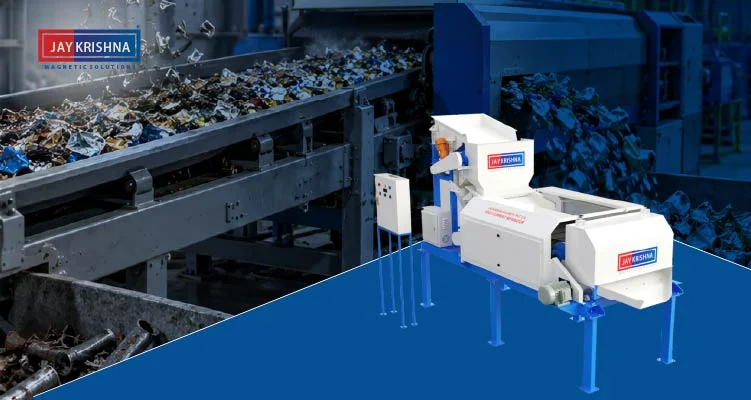
An Eddy Current Separator recovers non-ferrous metals such as aluminum, copper and brass from non-metallic waste, usually after ferrous metal has been removed. A rotor of magnets spins at high speed inside a non-metallic shell, and conductive particles passing over it develop eddy currents that repel them. They are thrown farther than plastic, glass or wood and divided by a splitter plate. Eddy current separation is a mature technology, so results depend on conductivity, particle size, particle shape and how evenly material reaches the rotor.
Jaykrishna Magnetics Pvt. Ltd.’s Eddy Current Separator page describes an eccentric rotor design, ferrite or NdFeB magnet blocks depending on the application, and sorting of particles down to about 2 mm. The JECS models run from JECS-20 (650 mm belt width) to JECS-60 (1650 mm). Those figures belong to that product line only. The page also shows installed units, including one in a PET recycling plant.
Which Separator Belongs at Each Stage of a Recycling Line?
Feeding, ferrous protection and non-ferrous recovery are configured according to the plant layout. Where tramp metal could damage a crusher or shredder, ferrous removal should be positioned upstream of that equipment. Additional ferrous cleanup can then be used before the eddy current stage.
| Line Stage | Equipment | Job It Does |
|---|---|---|
| Feeding | Tumbleback Feeder | Gives a consistent feed rate to shredders and hammer mills. |
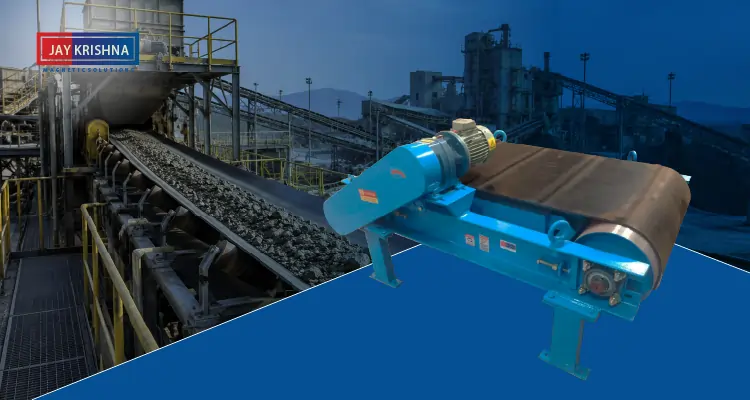
| Ferrous removal (suspended) | Overband Magnetic Separator | Removes tramp iron from the conveyor and can protect downstream crushers or shredders when installed upstream. |
| Ferrous removal (drum) | Drum Type Magnetic Separator | Separates magnetic ferrous contamination from non-magnetic material. |
| Non-ferrous recovery | Eddy Current Separator | Ejects conductive non-ferrous metals such as aluminum, copper and brass from non-conductive waste. |
| Optional weakly magnetic / paramagnetic separation | Roller Type Magnetic Separator | Applies a high-intensity, high-gradient permanent magnetic roller where weakly magnetic or paramagnetic material requires an additional separation stage. |
The exact sequence depends on your material and plant layout, so treat this as a starting framework, not a fixed process design.
Need the Right Separator Sequence for Your Recycling Line?
Send your material type, throughput, belt width and target metal fraction. Jaykrishna Magnetics Pvt. Ltd. can review the application and recommend a suitable separation configuration.
What Should Overseas Buyers Verify Before Sourcing from India?
Confirm four things in writing: performance on your material, certification scope, customization limits and the service plan. Apply the same checks to every supplier on your shortlist.
| Check | What to Ask | Why It Matters |
|---|---|---|
| Material fit | Reference data for your stream (particle size, moisture, metal mix). | Throughput and recovery vary by model and feed. |
| Rotor magnet configuration | Ferrite or NdFeB magnet blocks, and why the selected configuration fits the application. | Metal properties, particle size, rotor design and feed conditions can all affect separation performance. |
| Certification | ISO certificate and, where applicable, the CE Declaration of Conformity for the exact machine. | CE marking is the manufacturer’s declaration of conformity with applicable EU requirements; some conformity routes may also involve a notified body. |
| Customization | Belt width, drive, mounting and housing. | The machine must fit the conveyor and surrounding plant constraints. |
| Commercials | Lead time, packing, shipping terms and spares list. | These details are not published by default, so write them into the quotation. |
| References | Photos of installations in similar plants. | Helps show that the equipment has been applied to comparable material or process conditions. |
Jaykrishna Magnetics Pvt. Ltd.’s website references ISO certification, while a CE reference appears on Eddy Current Separator media. Overseas buyers should request the current documents, applicable machine scope and issue details as part of normal due diligence.
How Does Custom Engineering Change the Sourcing Equation?
It lets the machine fit your line instead of forcing your line to fit the machine. Many overseas recyclers are upgrading existing plants where conveyor width, discharge height and power supply are already fixed. A manufacturer that builds around your belt width, mounting constraints and process requirements can reduce the amount of structural modification needed for a retrofit.
Jaykrishna Magnetics Pvt. Ltd. invites customers to discuss customized magnetic and vibratory equipment. Customization adds engineering steps, so agree the specification early and confirm the schedule in writing.
What Information Speeds Up an Export Quotation?
A complete enquiry shortens the back-and-forth. Prepare:
- Material type and particle size range.
- Target throughput per hour.
- Existing belt width and conveyor speed.
- Whether you need ferrous removal, non-ferrous recovery or both.
- Moisture, dust or corrosive conditions on site.
- Destination country and local power supply.
If you are an importer or regional recycler weighing a longer-term supply relationship, Jaykrishna Magnetics Pvt. Ltd. also welcomes partners through its distributorship program.
Why Jaykrishna Magnetics Pvt. Ltd. for Recycling Separation?
Jaykrishna Magnetics Pvt. Ltd. was established in 1978 and is led by its second generation, with Jaykrishna M Maniar joining the family business in 1994. It manufactures permanent magnetic, electromagnetic, vibratory and mineral-processing equipment, and its Eddy Current Separator page documents installed units, including a PET recycling plant. The website references ISO certification, while a CE reference appears on Eddy Current Separator media, so buyers should request current documentation and scope for the exact machine. The broad product range is useful when a plant needs several separation stages from one source.
Conclusion
Global recyclers look to India because metal-recovery demand is rising, the engineering base is deep, and manufacturers can build to a specific line. The sound way to source is to verify performance, certification scope and service terms for every supplier, then match the equipment sequence to your material.
Planning a New Recycling Line or an Upgrade?
Share your material, throughput, conveyor dimensions and destination country with Jaykrishna Magnetics Pvt. Ltd. for an application-specific discussion. You can also write to info@jkmagnetic.com or call +91 93274 46310 / +91 98253 26078 (10:00 AM to 6:30 PM IST).
Let’s Discuss Your Requirements
FAQs
1. Can a magnetic separator manufacturer in India supply several stages of a recycling line?
In Jaykrishna Magnetics Pvt. Ltd.’s case, its recycling range covers feeding, ferrous removal and non-ferrous recovery equipment. The exact layout depends on your plant, so share your material, throughput and conveyor details.
2. Which magnet is better for recycling, ferrite or Neodymium?
Neither is universally better. Ferrite and Neodymium (NdFeB) provide different magnetic-field characteristics, and the appropriate configuration depends on the metal being recovered, particle size, rotor design, feed conditions and required separation performance. Fine-particle recovery may benefit from stronger field characteristics in some applications, but particle size alone should not determine the magnet material.
3. How do I confirm CE or ISO status before ordering?
Ask for the ISO certificate and, where CE marking is applicable, the Declaration of Conformity for the specific machine, then check the scope and issue details. CE marking is the manufacturer’s declaration that applicable EU requirements are met, although some conformity routes may also involve a notified body.
4. Does customization increase the lead time?
Customization can add engineering and approval steps because belt width, drive, mounting and other interfaces must be confirmed before manufacture. Standard lead times are not published, so request a written schedule with your quotation.
5. Can one eddy current separator handle e-waste, PET flakes and aluminum scrap?
The Jaykrishna Magnetics Pvt. Ltd. product page lists e-waste, PET flakes and aluminum scrap among Eddy Current Separator applications. Capacity differs by material, so confirm application-wise capacity and the required configuration for your stream with the manufacturer.
6. How do I start an export enquiry from overseas?
Use the quote form or write to info@jkmagnetic.com with your material, throughput, conveyor details and destination country. Phone lines are open 10:00 AM to 6:30 PM IST.